

Fifteen years ago today, on March 13, 2011, my 100th published article appeared in Daily Dawn’s Images on Sunday. The publication is now known as EOS. The piece, Holy Grail, explored the history of Cricket World Cup finals, revisiting iconic matches from 1975 to 2007 and the records that defined them. It was published when the 2011 Cricket World Cup was underway. At the time, it felt like a meaningful milestone in a journey that had been quietly unfolding through years of writing, reading, and learning.
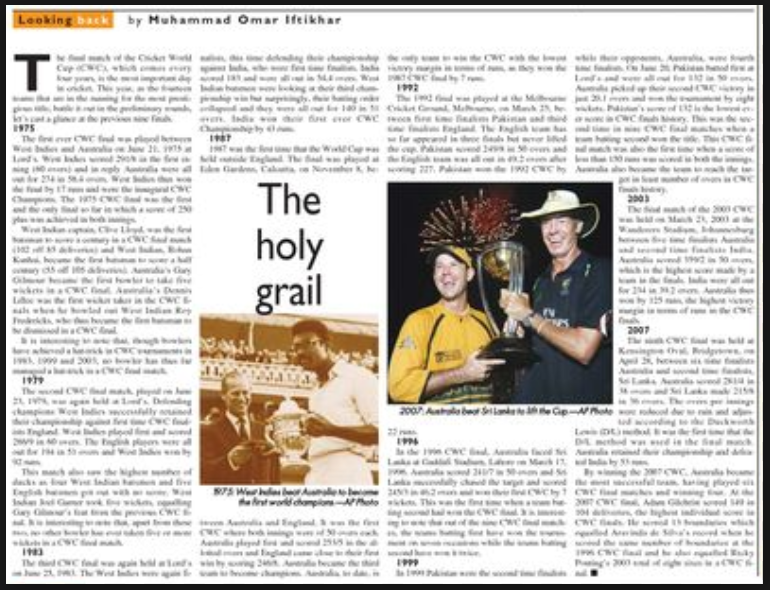
When that article was published, I was still developing my writing style. My approach to structuring articles relied on subheadings. Each section was carefully divided and organized, allowing the reader to move through the topic step by step. Subheadings were helpful tools. They provided clarity and helped me manage complex information, especially in analytical or historical pieces like the one on Cricket World Cup finals.
But writing, like any craft, evolves with time and practice. Over the years, I began to move away from relying too much on section breaks. Instead, I gradually started writing articles that flowed naturally through transitions between paragraphs. The narrative would move from one idea to the next, allowing the argument or story to develop more organically. It attracted te readers and it was fun to write as well. This shift, however, did not happen overnight. It came slowly as I read more, wrote more, and became more comfortable with the rhythm of language and storytelling.
Looking back, the 100th article represents a point in my writing journey when I was still refining my voice. It reminds me of a time when every published article offered an opportunity to experiment with structure, tone, and perspective. This 100th article itself reflected something that has always fascinated me: the stories hidden within sports history. The Cricket World Cup finals are more than just matches. They are moments that capture drama, unexpected victories, legendary performances, and shifting eras in international cricket.
However, the larger story remains beyond that single article. Since then, my writing journey has continued to expand in ways I could not have fully imagined at the time. What began as individual pieces published in newspapers and magazines eventually grew into a body of work that now includes more than 1,000 published articles.
Each article represents a moment of curiosity, research, and reflection. Over time, writing became not just a profession but a continuous process of thinking through ideas and sharing them with readers.
Reaching the milestone of 1,000 published articles was never something I planned from the beginning. It happened gradually, article by article, year by year. And yet, when I look back, that 100th article stands out as a milestone that led me to continue marching towards article number 1,000 and beyond. Fifteen years later, my 100th article remains a reminder that every long journey begins with small steps.
Read my 100th Article:
Article # 100
The holy grail
Published in Dawn Magazine
(Dawn Images on Sunday)
Sunday, March 13, 2011
The final match of the Cricket World Cup (CWC), which comes every four years, is the most important day in cricket. This year, as the fourteen teams that are in the running for the most prestigious title, battle it out in the preliminary rounds, let’s cast a glance at the previous nine finals.
1975: The first ever CWC final was played between West Indies and Australia on June 21, 1975 at Lord’s. West Indies scored 291/8 in the first inning (60 overs) and in reply Australia were all out for 274 in 58.4 overs. West Indies thus won the final by 17 runs and were the inaugural CWC Champions. The 1975 CWC final was the first and the only final so far in which a score of 250 plus was achieved in both innings.
West Indian captain, Clive Lloyd, was the first batsman to score a century in a CWC final match (102 off 85 deliveries) and West Indian, Rohan Kanhai, became the first batsman to score a half century (55 off 105 deliveries). Australia’s Gary Gilmour became the first bowler to take five wickets in a CWC final. Australia’s Dennis Lillee was the first wicket taker in the CWC finals when he bowled out West Indian Roy Fredericks, who thus became the first batsman to be dismissed in a CWC final. It is interesting to note that, though bowlers have achieved a hat-trick in CWC tournaments in 1983, 1999 and 2003, no bowler has thus far managed a hat-trick in a CWC final match.
1979: The second CWC final match, played on June 23, 1979, was again held at Lord’s. Defending champions West Indies successfully retained their championship against first time CWC finalists England. West Indies played first and scored 286/9 in 60 overs. The English players were all out for 194 in 51 overs and West Indies won by 92 runs. This match also saw the highest number of ducks as four West Indian batsmen and five English batsmen got out with no score. West Indian Joel Garner took five wickets, equalling Gary Gilmour’s feat from the previous CWC final. It is interesting to note that, apart from these two, no other bowler has ever taken five or more wickets in a CWC final match.
1983: The third CWC final was again held at Lord’s on June 25, 1983. The West Indies were again finalists, this time defending their championship against India, who were first time finalists. India scored 183 and were all out in 54.4 overs. West Indian batsmen were looking at their third championship win but surprisingly, their batting order collapsed and they were all out for 140 in 51 overs. India won their first ever CWC Championship by 43 runs.
1987: 1987 was the first time that the World Cup was held outside England. The final was played at Eden Gardens, Calcutta, on November 8, between Australia and England. It was the first CWC where both innings were of 50 overs each. Australia played first and scored 253/5 in the allotted overs and England came close to their first win by scoring 246/8. Australia became the third team to become champions. Australia, to date, is the only team to win the CWC with the lowest victory margin in terms of runs, as they won the 1987 CWC final by 7 runs.
1992: The 1992 final was played at the Melbourne Cricket Ground, Melbourne, on March 25, between first time finalists Pakistan and third time finalists England. The English team has so far appeared in three finals but never lifted the cup. Pakistan scored 249/8 in 50 overs and the English team was all out in 49.2 overs after scoring 227. Pakistan won the 1992 CWC by 22 runs.
1996: In the 1996 CWC final, Australia faced Sri Lanka at Gaddafi Stadium, Lahore on March 17, 1996. Australia scored 241/7 in 50 overs and Sri Lanka successfully chased the target and scored 245/3 in 46.2 overs and won their first CWC by 7 wickets. This was the first time when a team batting second had won the CWC final. It is interesting to note that out of the nine CWC final matches, the teams batting first have won the tournament on seven occasions while the teams batting second have won it twice.
1999: In 1999 Pakistan were the second time finalists while their opponents, Australia, were fourth time finalists. On June 20, Pakistan batted first at Lord’s and were all out for 132 in 50 overs. Australia picked up their second CWC victory in just 20.1 overs and won the tournament by eight wickets. Pakistan’s score of 132 is the lowest ever score in CWC finals history. This was the second time in nine CWC final matches when a team batting second won the title. This CWC final match was also the first time when a score of less than 150 runs was scored in both the innings. Australia also became the team to reach the target in least number of overs in CWC finals history.
2003: The final match of the 2003 CWC was held on March 23, 2003 at the Wanderers Stadium, Johannesburg between five time finalists Australia and second time finalists India. Australia scored 359/2 in 50 overs, which is the highest score made by a team in the finals. India were all out for 234 in 39.2 overs. Australia thus won by 125 runs, the highest victory margin in terms of runs in the CWC finals.
2007: The ninth CWC final was held at Kensington Oval, Bridgetown, on April 28, between six time finalists Australia and second time finalists, Sri Lanka. Australia scored 281/4 in 38 overs and Sri Lanka made 215/8 in 36 overs. The overs per innings were reduced due to rain and adjusted according to the Duckworth Lewis (D/L) method. It was the first time that the D/L method was used in the final match. Australia retained their championship and defeated India by 53 runs.
By winning the 2007 CWC, Australia became the most successful team, having played six CWC final matches and winning four. At the 2007 CWC final, Adam Gilchrist scored 149 in 104 deliveries, the highest individual score in CWC finals. He scored 13 boundaries which equalled Aravinda de Silva’s record when he scored the same number of boundaries at the 1996 CWC final and he also equalled Ricky Ponting’s 2003 total of eight sixes in a CWC final.
Muhammad Omar Iftikhar is an author, columnist, and fiction writer with over 20 years of writing experience. He has published over 1,000 articles in Pakistan’s print media and is the author of four books. His debut novel, Divided Species (2020), is a science fiction story set in Karachi. His other books include 20 Steps to Writing Articles (2022), Recreate Your Tomorrow! (2023), and Player AI (2024). He has been a public speaker for over a decade, conducting more than thirty sessions for various brands and organizations.