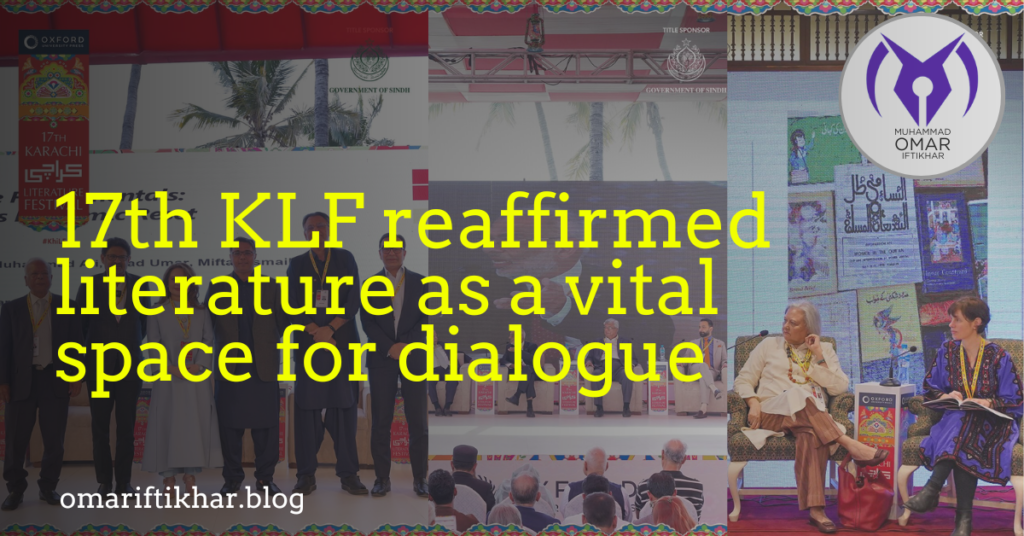
The 17th Karachi Literature Festival (KLF-2026) was held in Karachi from February 6–8, 2026, bringing together writers, thinkers, and readers at a time of global uncertainty. Against this shifting backdrop, the festival celebrated literature’s enduring power to connect and challenge, offering a platform for reflection and dialogue. Through conversations that crossed cultures and disciplines, KLF-2026 strengthened the cultural, creative, and communal threads that bind us together.
The inaugural session was graced by he presence of Arshad Saeed Husain, Managing Director, Oxford University Press Pakistan; Lance Domm, British Deputy High Commissioner, who was the Guest of Honor; Alexis Chahtahinsky, Consul General France, who was also the Guest of Honor: Syed Murad Ali Shah, Chief Minister, Sindh, who was the Chief Guest. Keynote Speakers were Nasir Abbas Nayyar, Writer,critic, columnist, and Senator Sherry Rehman, Former Federal Minister for Climate Change.
The festival opened with a moment of silence in solidarity with victims of recent acts of violence, setting a reflective tone for discussions on literature, culture, and contemporary challenges. Featuring over 200 speakers, 28 book launches, and a wide range of panels and performances, KLF-2026 underscored literature’s role in fostering empathy, dialogue, and social understanding.
Book Awards
The following authors won the KLF-Getz Pharma awards:
• English Fiction: Ferdowsnama by Shandana Minhas
• Urdu Poetry: Aahang by Dilawar Ali Aazar
• Urdu Prose: Namak KI Betiyan by Naseer Soomro
Javed Jabbar was in conversation with Ayesha Tammy Haq on thr topic, Jinnah’s Vision for a Plural Pakistan.During his talk, Javed Jabbar reflected on what he described as the profound injustice done to Mr. Jinnah’s vision of a plural Pakistan. He clarified that pluralism is not merely about social or cultural diversity, but about the coexistence of multiple political viewpoints within a democratic framework. In this context, he argued, Pakistan’s history has repeatedly departed from Jinnah’s ideals. Jabbar pointed to periods of military intervention as a clear and sustained violation of that vision, stressing that the sidelining of democratic plurality undermined the very foundations on which Pakistan was meant to stand.
The festival’s cultural programme extended seamlessly into a Sindhi mushaira, presided over by Madad Ali Sindhi and conducted by Naseer Mirza. The session brought together a distinguished group of poets—Adal Soomro, Sahar Imdad Hussaini, Attiya Dawood, Niaz Panhwar, Bakhshan Mehranvi, Saabhiyan Sangi, Sher Mehrani, Amar Pirzado, Shahnawaz Ghoto, Masroor Pirzado, and Naseer Soomro—whose recitations reflected the depth, resistance, and lyrical richness of Sindhi poetry. Continuing the focus on contemporary expression and identity, Saba Karim Khan moderated the screening of the documentary W.R.A.P (We Really Are Pakistan). The screening was followed by a dynamic live performance by rappers from Gizri, underscoring the festival’s engagement with emerging voices and urban cultural narratives. Visual art and travel writing came into focus in a conversation between Jeff Koehler and Niilofur Farrukh on Koehler’s book Matisse in Morocco: A Journey of Light and Color, which explored the intersections of art, place, and creative influence.
Book Launches:
The following books were launched at the KLF 2026:
• Language, Gender and Power by Shahid Siddiqui
• Reimagining Education in Pakistan: Contemporary Challenges & Creative Choices by Shahid Siddiqui
• Oxford kay roz-o-shab by Muhammadi Begum
• Nai Purani Roosi Kahanyan by Dr. Najam Butt
• A Beautiful Despair – The Art and Life of Meher Afroz edited by Niilofur Farrukh
• Soliloquies? Existing on Earth On The Sea & Samandar Paar by Tariq Alexander Qaiser
• Misspelled Constellations: A Poetic Cartography of Karachi by Sorina Zainea
• The Missing Prayer by Ammar Aziz
• Coming Back: The Odyssey of a Pakistani Through India by Shueyb Gandapur
• Chaska Galyun Ka by Qamar Bharoocha Bana
• Diwan e Ruh Series: Book I and II by Zainab Jabbar
• When the Fireflies Dance: A Novel by Aisha Hassan
• Dream Work of Lisa D by Adrian Husain
Gulgee Museum: The Handbook
The 17th Karachi Literature Festival reaffirmed its importance as one of Pakistan’s most inclusive and intellectually rigorous cultural platforms. The festival’s carefully curated sessions spanning literature, education, public interest, culture, youth engagement, and the arts demonstrated a sustained commitment to dialogue across languages, disciplines, and generations. By bringing together established writers, emerging voices, scholars, artists, students, and the wider public in an open and accessible space, KLF-2026 embodied the spirit of its theme, Literature in a Fragile World. The diversity of sessions, from serious debates on democracy, media, climate change, and education to poetry, performance, and visual culture, highlighted literature’s capacity to respond meaningfully to uncertainty and complexity. More than a literary event, the festival functioned as a civic forum, one that encouraged critical thinking, empathy, and collective reflection. In doing so, the 17th KLF strengthened Karachi’s position as a vital hub of cultural and intellectual exchange and reaffirmed literature’s enduring relevance in shaping public conversation.
Muhammad Omar Iftikhar is an author, columnist, and fiction writer with over 20 years of writing experience. He has published over 1,000 articles in Pakistan’s print media and is the author of four books. His debut novel, Divided Species (2020), is a science fiction story set in Karachi. His other books include 20 Steps to Writing Articles (2022), Recreate Your Tomorrow! (2023), and Player AI (2024). He has been a public speaker for over a decade, conducting more than thirty sessions for various brands and organizations.